
On the Value of an Education
A man told me recently that the purpose of education is to get a job. He said it plainly, the way people deliver settled facts. I let it stand, because some claims are better answered on the page than across a table.
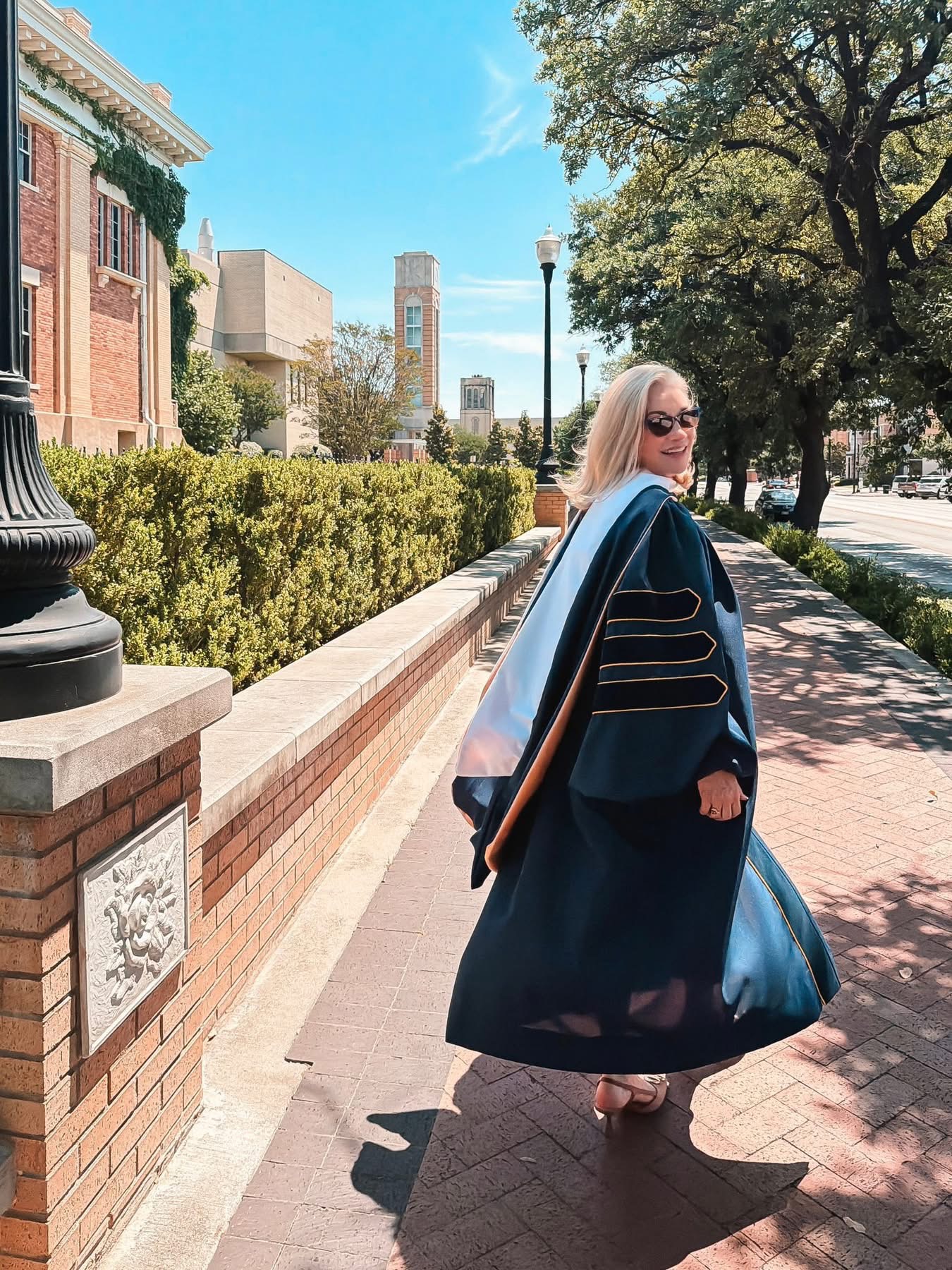
This past month, at 64, I finished my doctorate. By his arithmetic I have overspent wildly. A dual undergraduate diploma. Two master’s degrees. A degree in theology. Now a Ph.D. I am long past needing another line on a résumé to earn a living. If education were only the key to employment, I should have stopped decades ago, fully credentialed and done.
But I didn’t stop. There were seasons when I nearly did; my best friend wrote in my graduation card that there were moments she thought I would. Life threw a great deal at me during these years. And in those exact seasons, the work of learning was not a luxury to set aside. It was the floor I stood on: structure when everything else had gone unstructured, a discipline to return to when grief or fear made the days shapeless. I have been grounded by inquiry the way other people are grounded by routine. Because for me, inquiry is the routine: the daily, demanding work of venturing a conjecture and then doing my honest best to prove it wrong.
That is the part the man missed. Education did not hand me a job; it changed how I think. It took a restless, tangential, racing mind and taught it to hold still long enough to follow an idea all the way down. It taught me the very distinction my friend named so precisely in her card: the difference between disciplined inquiry and mere opinion. It taught me to want criticism: to hear an objection not as an attack but as a gift, a correction on the road toward a better idea and a better self. And it humbled me, again and again, which is its own quiet kind of grace.
It also widened the world. I was raised within the professional horizons available to my parents. They were good and decent horizons, but finite ones. Education lifted that ceiling, and then it deepened everything beneath it: my faith, which has more room in it now; my travels, which I read differently; the science I can follow; the people I can truly meet, because learning is, in the end, a way of becoming someone capable of deeper connection. A degree is a credential. An educated life is a larger house to live in.
There is something else, less often said, and it is the thing I most want to say. None of these degrees were earned alone. My pursuit of learning gave the people who love me a place to stand: something to root for, errands to run, a finish line to wait beside, a graduation to attend with tears in their eyes. So before anything else, let me give thanks: to my husband, to my children, stepchildren, and grandchild, to the friends and professors and family who carried what they could so that I could carry the rest. Their belief was not incidental to the work; it was part of the work. To be supported like that, and then celebrated, has been its own education in what love quietly does. And it has modeled something for every age around me: that learning is not the private property of the young, that a person can keep beginning, and that the people beside her will keep showing up.
This, I have come to see, is the family language. My husband carries his own discipline through an MBA. Our children hold a medical doctorate at the fellowship level, a juris doctorate, and two engineering degrees, one of them now back at it, pursuing a master’s in public policy and cybersecurity. We are a household that believes the same unspoken thing: that learning is an inheritance you can hand down and never deplete.
You cannot tax it.
You cannot lose it in a market.
No one can ever take it away.
My best friend wrote those last words in my graduation card. She was right.
So, to the man who told me what education is for: you were not wrong that it can open the door to a job. You were only wrong about the size of the door. The job is the smallest door in a very large house, and I have spent my life learning to live in all the other rooms.
Paige Talley Ellison, Ph.D.